
History of King Tran’s seal opening ceremony at Tran Temple in Nam Dinh every year
History of King Tran’s seal opening ceremony at Tran Temple in Nam Dinh every year
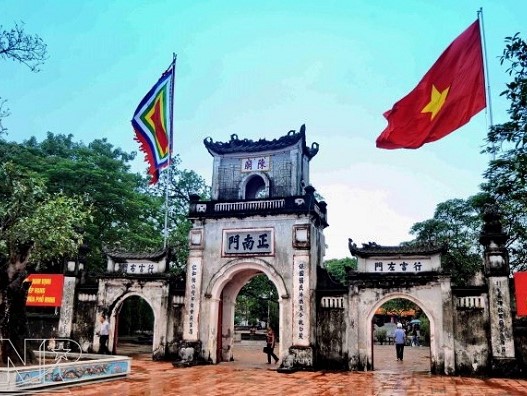
King Tran’s Sealing Ceremony is an ancestral sacrifice ceremony originating in the Tran Dynasty in 1239 (13th century). This ritual is a long-standing cultural practice associated with the first victory of King Tran Nhan Tong against the Mongol invaders. Tran Temple in Nam Dinh is a temple for kings of the Tran Dynasty, located at Tran Thua Street, Loc Vuong Ward, Nam Dinh City. Tran Nam Dinh Temple was recognized as a national historical and cultural relic in 1962.
In 1822, King Minh Mang ordered the seal to be re-engraved because the old seal had disappeared after several centuries. On the old seal is engraved: “Tran dynasty chi bao”, while the new one is engraved: “Tran dynasty dictionary” to recall the good old customs. The lower part of the new seal is also engraved with the sentence “Tyuc phuc uong anh”. “Tran temple dictionary” is the seal used to seal the current Tran Temple festival. in the Nguyen Dynasty, late 19th century, early 20th century.
The Opening Ceremony takes place from 12pm (ie Rat time) on January 14 to early morning on January 15 every year. Starting from Co Trach Temple, the elderly people dressed in turban and the villagers gathered in large numbers to step by step celebrate the saints and attend the solemn ceremony of King Tran’s seal opening. The ark is placed on the altar. Inside the box were two bronze seals. The small fruit on the face has two words: “Tran temple” and the large fruit has the word: “Tran dynasty dictionary four blessings of no kingdom” are engraved in the style of the seal. The ceremony began with a burst of firecrackers. An old man stood on behalf of the people in the village to perform the ceremony. After that, the procession of people carrying the casket (the seal) followed the beat of the fire gong drum and the light of the candles to Thien Truong Temple to celebrate. The priest places a solemn “message” in front of the celebrant. When the gongs and drums sound, the celebrant stamps red ink on the papyrus and writes the date and year so that the last word always falls on the word “birth” in the order “birth-age-sickness-death”. According to legend, those who ask for a red seal to hang at home will exorcise demons, neutralize bad luck, attract luck and be favorable in the path of career advancement.

On the morning of the 15th, the people of seven villages: Voc, Loc, Hau Boi, Bao Loc, Kenh, Bai, Tuc Mac took the palanquin to the courtyard of Thuong Temple to sacrifice to King Tran. In each of these villages, there is a place to worship famous generals of the Tran Dynasty. The incense offering ceremony had 14 virgin girls (unmarried daughters), each wearing a fruit tray, entering the temple and offering 14 thrones to the king. This ritual is modeled after the style of the old feudal court. For even years, the association is larger than for odd years. Along with the procession, Tran Temple holds a water procession. The celebrant will ask for 1 incense stick in the Ancestral incense bowl and 14 incense sticks in the 14 Kings’ altars, then plug them all into the communal incense bowl and place it on the palanquin. The group will wear the sea flag costume to worship the palanquin to go to the temple gate to sacrifice to heaven and earth, then continue the procession 3 km to Huu Be wharf on the banks of the Red River. Arriving at the river wharf, the celebrant brought a water bottle to the flower boat to row out to the middle of the river in harmony with the sound of gongs and drums. The celebrant fills the jar with water, then paddles ashore, puts it on a palanquin, and carries it back to the temple along the old way. Returning to the temple, the water in the jar will be drawn into a bowl and then placed on the altar to sacrifice water. After the sacrifice, bowls of water will be given to the people of the Tran family to drink and remember their roots and ancestors.

On the morning of January 16, the fish sacrifice ceremony was held at Thien Truong Temple. Fish and carp (corresponding to the two ancestors of the Tran family, Tran Kinh and Tran Ly) are placed in barrels of red paint, sacrificed from early morning to noon, then released into the Red River. Outside, there will be folk games for people and tourists. But visitors from all over the world don’t need to wait for the main festival, already flocking to Tran temple. Everyone wishes for good things, peace, prosperity.
The annual Tran Temple Festival is an opportunity for compatriots throughout the country and overseas Vietnamese to come here to burn incense, commemorate and express gratitude to the Tran kings, thereby educating the tradition and morality of “Drinking water, remember the source”, raising the awareness of preserving, preserving and promoting the historical and cultural values of the nation.
At the same time, this will be an opportunity to connect the Special National Relic Area – the Tomb and Temple of the Tran kings into a historical – cultural – spiritual tourist route of the whole country.
Views: 1215


Spis treści Zrozumienie warunków obrotu bonusem Proces wypłaty krok po kroku Weryfikacja konta (KYC) i jej znaczenie Częste problemy...
Inhalt Was ist KYC und warum ist es notwendig? Der Schritt-für-Schritt KYC-Prozess im Tower Casino Welche Dokumente Sie bereithalten...

Great with the model of Taylor Swift’s success – Country music princess Taylor Swift was born on December 13,...

The phone connoisseurs heat up with the launch of the super product Galaxy S23 Ultra in Vietnam In Vietnam,...

Agoda (Nasdaq: BKNG) is one of the fastest growing online travel service providers. Founded in 2007, the small startup...


 Visit Today : 24
 Visit Yesterday : 351
 Total Visit : 128287
 Who's Online : 2